
Is the Historic Tech Crash Driven by Panic Selling or a Real Cycle Turn?

 Prefer us on Google


Recently, global financial markets have experienced significant volatility, with cyclical stocks and momentum factors undergoing historic pullbacks, leading to heightened concerns about the peak of the economic cycle.
Andrew Sheets, the global head of fixed income research at Morgan Stanley, believes that the current sharp price adjustments are more likely indicative of a concentrated clearing of significant uncertainty rather than a precursor to the end of the economic cycle.
On a macro level, several key leading indicators have not signaled a peak in the cycle—the global manufacturing PMI remains strong, the U.S. yield curve is still positively sloped, and bank loan growth is rising in the U.S., Europe, and Asia.
Meanwhile, the Democratic Party's historic victory in the U.S. midterm elections could be a positive for the bond market: the slowdown in AI data center construction may extend the financing timeline, and downward pressure on energy prices may be reinforced as a result.
Morgan Stanley maintains its global growth forecast for the next 6 to 12 months, expecting U.S. economic growth to exceed 2% and Europe to exceed 1%. Andrew Sheets noted that the market could complete its adjustments before uncertainty fully dissipates, especially after valuation corrections have quietly persisted for some time.
No Peak Signals from Cycle Indicators
Andrew Sheets pointed out that the current market volatility resembles typical characteristics seen at the end of previous economic cycles, but several core indicators do not support this judgment.
The global manufacturing PMI continues to remain strong, with recent U.S. PMI data exceeding expectations; the U.S. leading economic indicators index shows signs of improvement; bank loans in the U.S., Europe, and Asia are all expanding; and credit fundamentals are continuously improving. The latest readings from Morgan Stanley's cross-asset team's cycle model indicate that the economy is still in a healthy range.
Another closely watched indicator—the yield curve—has also not issued warnings. Whether looking at the 2-year and 10-year or the 3-month and 10-year spreads, the yield curves in the U.S., U.K., Germany, and Japan all maintain a positive slope. This contradicts scenarios of excessive monetary policy tightening and an impending downturn in economic growth.
Andrew Sheets stated that historically, true cyclical turning points are rarely preceded by such robust patterns in the aforementioned indicators.
Midterm Election Impact on AI Construction Expectations
The Democratic Party's significant victory in the U.S. midterm elections flipped control of the House, Senate, and several governorships, including Texas and Ohio, achieving the strongest excess performance in national votes since 1974.
The election results have sparked market concerns that AI infrastructure construction may face stricter regulations. However, Andrew Sheets believes that while this risk exists, it is not the baseline scenario and is not a new issue.
Semiconductor stocks had already fallen about 30% from their June peak before election day. The Morgan Stanley research team has previously pointed out that bottlenecks in power and financing could slow the AI construction process and extend the cycle.
Even in the most pessimistic high-constraint scenario—assuming project approvals and power supply face greater challenges—the forecast for the compound annual growth rate of global data center capacity until 2030 still stands at 17%.
From the stock market perspective, the risks of delays in AI construction need to be weighed against the significant valuation adjustments that have already occurred. The forward P/E ratio of the S&P 500 has decreased by about 19% since the beginning of the year. Morgan Stanley equity strategists believe that this adjustment has been quietly underway within the market for quite some time.
Bond Market May Experience Dual Benefits
Andrew Sheets believes that the potential positive impact of the midterm election results on the bond market is more direct.
He pointed out that the two major pressures troubling the bond market this year—high energy prices and large-scale borrowing for data center construction—may be alleviated due to the election results.
- First, the slowdown in AI construction means that related financing needs will be spread over a longer time dimension, reducing the supply pressure that the market needs to digest in any single period.
- Second, according to election analysis cited by Vice President Vance, voter unease over the situation with Iran was one of the important factors influencing the election results. This may prompt the market to lower the risk premium for a further escalation of geopolitical conflicts—oil prices are currently about 17% lower than at the end of October.
The decline in energy prices is particularly critical for Europe. Morgan Stanley's interest rate strategists currently favor a steepening strategy for the European yield curve. Morgan Stanley's emerging markets strategists also noted that lower oil prices will improve the fundamentals of emerging markets from multiple dimensions.
Additionally, the general dissatisfaction among voters regarding inflation may further strengthen market expectations that tariff measures will ultimately prove to be temporary policies. At the same time, a larger majority in Congress is expected to reduce the space for individual legislators to obstruct, eliminating a factor of market volatility caused by previous congressional games.
Andrew Sheets concluded that the most critical question at present is: Is the market experiencing a true cyclical turning point, or is it approaching the end of a concentrated clearing of significant uncertainty?
His judgment leans towards the latter. Cyclical data still provides support, while the midterm election results may be alleviating the two biggest pressures facing the bond market this year. Morgan Stanley will continue to test this judgment with subsequent evidence.
-- Price
This content is provided for general informational purposes only and doesn't constitute financial, investment, legal, or tax advice. Any events, rewards, online promotions, or related information mentioned herein should not be considered a recommendation, solicitation, or invitation to purchase, sell, trade, or otherwise deal in any crypto assets. Crypto assets are highly volatile and may result in loss. The availability of WEEX services, products, and related events may vary by region. You are responsible for ensuring that your participation is in accordance with applicable local laws and regulations.
You may also like

Binance’s Yi He warns suspicious USDT deposits could trigger fund freezes

JPMorgan Expects Bitcoin Annualized Return of 10%, Higher Than Other Assets

JPMorgan Predicts 10% Annualized Return for Bitcoin and Includes It in 2027 Capital Market Assumptions

New Jersey Drops Coinbase Staking Order After Three Years

Goldman Sachs Predicts Global Data Center Investment Demand of Approximately $8.5 Trillion Over the Next Five Years

The Need for a Benchmark Interest Rate in DeFi: Will Treehouse DOR Become the New Standard for On-Chain Finance?

Bitwise Raises Bitcoin Price Prediction to $1.6 Million by 2036

Robinhood reports $173 million from prediction markets as crypto revenue declines

Ex-Messari analyst advocates token buybacks for crypto holders

Morgan Stanley Raises Global Electricity Growth Forecast: Who Will Share the $500 Billion Increment in the Power Market Beyond AI?

Proposal to Terminate Community Multisig Cancellation Rights

Bitcoin: Why JPMorgan Reports an Average Return of 20.9% but Only 10% Per Year

JPMorgan Estimates 10% Annual Return for Bitcoin, but with High Volatility
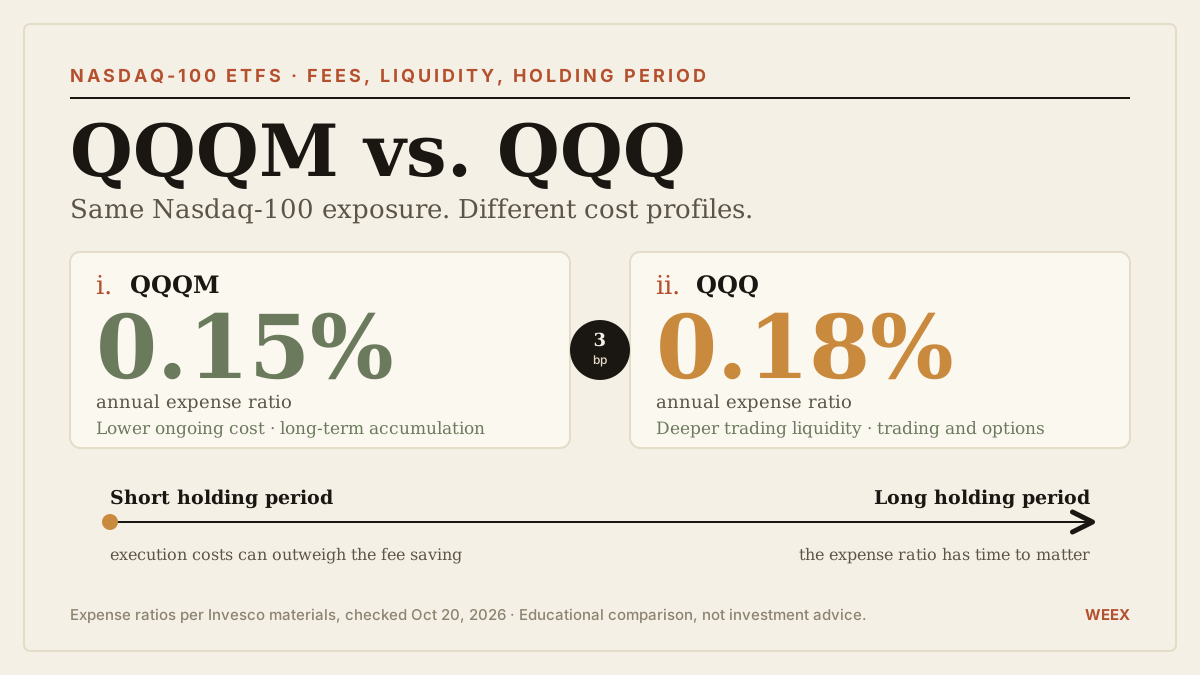
QQQM vs. QQQ in 2026: Fees, Liquidity and Long-Term Investing Compared
Compare QQQM vs. QQQ in 2026: current fees, trading costs, long-term savings, and when switching an existing investment may cost more than it saves.

Bitcoin Expected to Outperform Major Assets in Annual Return Forecast

Tiger Research: The Second Growth Curve of the Korean Crypto Market - RWA and Compliant Stablecoins

Strive CEO Emphasizes Going Long on Bitcoin and Short on USD, Claims Currency Depreciation is Irreversible

Firelight forces XRP-linked tokens lockup as withdrawal delay queue grows
Strive’s new $500 million Bitcoin financing plan comes with a $257 million annual dividend problem

Ethereum Staking: Interactive Brokers Launches Service for Eligible Clients via ZeroHash

StoneX raises Securitize price target to 18, maintains buy rating

Bitcoin beats gold and stocks with 633% real return, study finds

Compound Community Proposes Transferring EPCF Fund Control to Multi-Signature Scheme
What Is Warren Buffett’s S&P 500 Investing Advice? Key Lessons for Volatile Markets
Learn Warren Buffett’s S&P 500 index fund advice, how the 90/10 rule works, and how to build a long-term plan for volatile markets.

Bitcoin Could Reach $500,000 by 2030, Says Strive CEO
Mary Daly: Future Rate Hikes Depend on Persistence of Inflationary Shocks

LONG Launches Community Vault LP Upgrade Feature, Supporting Stock Token Liquidity Provisioning
What is Concrete (CT) TGE? Can Institutional DeFi Drive More Gains?

BlackRock: AI Drives Adoption of Digital Assets, Stablecoins May Become Major Trading Tools

Strive CEO Aims to Increase Bitcoin Treasury Leverage Ratio to Over 60% This Year
Binance’s Yi He warns suspicious USDT deposits could trigger fund freezes
JPMorgan Expects Bitcoin Annualized Return of 10%, Higher Than Other Assets
JPMorgan Predicts 10% Annualized Return for Bitcoin and Includes It in 2027 Capital Market Assumptions
New Jersey Drops Coinbase Staking Order After Three Years
Goldman Sachs Predicts Global Data Center Investment Demand of Approximately $8.5 Trillion Over the Next Five Years
The Need for a Benchmark Interest Rate in DeFi: Will Treehouse DOR Become the New Standard for On-Chain Finance?
Latest articles


Latest coin listings on WEEX


